An Extension Power Strip can bring outlets closer to a desk, workbench, or sofa, reducing the daily shuffle of chargers and lamps. The benefit is practical: one accessible power point can serve several devices. But convenience is not a safety rating. Check the strip’s wattage limit, cord condition, and certification label, and avoid hiding it under rugs or behind heat-producing equipment.
Safety data deserves attention. The National Fire Protection Association’s 2013 report, Home Fires Involving Extension Cords, estimated about 3,300 U.S. home structure fires involving extension cords each year from 2007 to 2011. Those figures concern extension cords broadly, not power strips alone, so they should not be treated as a direct risk estimate for every Extension Power Strip. Still, they show why placement and load matter. The Electrical Safety Foundation International’s president, Brett Brenner, has emphasized the practical rule that extension cords are for temporary use, not permanent wiring. That distinction is easy to miss. A tidy strip behind a cabinet can look harmless, yet remain hard to inspect. Choosing a well-rated product helps, but it cannot correct an overloaded outlet or damaged cable. The right choice depends on the room, connected devices, and how long the setup will stay in place. Convenience matters. So does a quick visual check.
What an Extension Power Strip Is
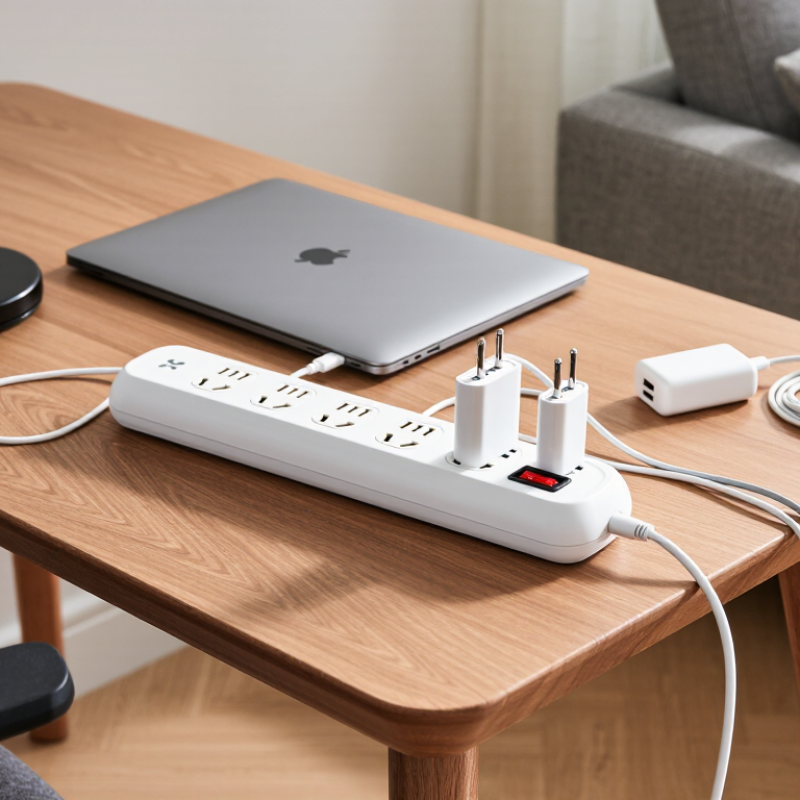
An extension power strip is a portable electrical accessory with a cord and several outlets in one housing. It extends the reach of a wall outlet and lets you connect multiple low-power devices nearby, such as a desk lamp, phone charger, and laptop. Some models include a switch or surge protection, but these features are not standard. Check the product label rather than assuming every strip offers the same protection.
The strip does not create extra electrical capacity. Its safe load depends on its rating and the total power drawn by connected devices. A compact strip behind a desk may look convenient, but tightly bundling its cord or hiding it under a rug can trap heat. High-power appliances, including space heaters, are generally better plugged directly into a wall outlet, following their instructions. I still find the term confusing: a strip adds sockets, not unlimited power.
Tips: Read the rated load before plugging in devices. Keep the strip dry and uncovered, and replace it if the cord is cracked, loose, or unusually warm. Avoid connecting one power strip to another.
| Feature | What It Is | Why It Matters |
|---|---|---|
| Basic definition | A power strip is a portable electrical accessory with multiple outlets connected to one supply plug. An extension power strip also has a cord to place those outlets farther from a wall receptacle. | It lets several compatible devices share one accessible outlet location without changing the building’s fixed wiring. |
| More outlet access | The number and arrangement of outlets vary by model. Some designs space outlets to accommodate larger plugs or adapters. | It can make a desk, media area, or workbench easier to organize. Check the outlet layout against the plugs you plan to use. |
| Added reach | The attached cord extends the connection between a wall receptacle and the strip. Cord length and permitted use are specified by the product’s labeling. | Choose a cord long enough for the intended location, but do not run it where it can be pinched, damaged, or create a trip hazard. |
| Electrical capacity | Each strip has a rated voltage and maximum current or power. The rating is marked on the product or its documentation and must not be exceeded. | A strip provides additional outlets, not additional electrical capacity. Add up the connected devices’ loads and stay within the strip’s rating and the circuit’s limits. |
| Surge protection | Surge suppression is a separate feature and is not included in every power strip. A product with this feature should be specifically labeled as a surge protector. | If protection from voltage surges is needed, verify that the selected model is designed and rated for surge protection; outlet count alone does not indicate it. |
| Overload protection | Some models include an overload switch or circuit breaker; others may not. Features should be confirmed on the product label or instructions. | Do not assume a strip will automatically prevent every overload. Disconnect devices if the strip becomes unusually hot, smells burnt, or shows damage. |
| Indoor or outdoor use | Many power strips are intended for dry, indoor locations. Outdoor use requires a product specifically rated for the environment and conditions. | Using indoor-only equipment outdoors or in damp areas can create an electrical hazard. Follow the stated location and use instructions. |
| Safe connection practices | Power strips should be plugged directly into a suitable wall receptacle, rather than connected in a chain with another strip or extension cord. | Avoiding daisy-chaining and keeping the strip uncovered helps reduce risks associated with overloading and heat buildup. |
| Best suited for | Low- to moderate-power electronics and other devices whose combined load is within the strip’s rating, subject to the manufacturer’s instructions. | For high-power appliances or equipment with specific connection requirements, use the connection method recommended by the manufacturer instead of assuming a power strip is suitable. |
FAQS
It brings several outlets closer to a desk, sofa, or workbench. It adds access, not electrical capacity.
Yes, if their combined power stays within the strip’s rated load. Check the label and add up device wattages. Not unlimited power.
High-power appliances, such as space heaters, are generally better plugged directly into a wall outlet. Follow each appliance’s instructions.
Look for clear voltage and current ratings, grounded outlets, and a resettable circuit breaker. Surge protection is a separate feature.
Choose a length that reaches without stretching. Keep it out of walkways and away from places where furniture could pinch it. Small detail, big difference.
No. Keep it uncovered, dry, and away from rugs so heat does not build up unnoticed.
Avoid connecting power strips together. Extra sockets can make it tempting, but they do not increase the outlet’s capacity.
Stop using it if the cord is cracked, sockets feel loose, or the strip becomes unusually warm. A tidy setup is not worth ignoring those signs.
Conclusion
An Extension Power Strip is a practical way to make power more accessible when wall outlets are limited or inconveniently placed. By connecting to a single outlet, it provides several additional sockets and can help keep everyday devices within reach. Features such as a suitably long cord, spaced outlets, an on/off switch, and clear capacity information can make a power strip easier to use at home or in a workspace.
Choosing the right Extension Power Strip starts with considering how many devices you need to connect, where it will be used, and how far it must reach. Check its rated capacity and safety features, and avoid connecting more equipment than it is designed to handle. Keep the strip in a dry, well-ventilated area, and inspect it regularly for damage. Matching these details to your needs helps support convenient, responsible everyday use.
